The product and the problem
Apaale is a two-sided logistics product for customers who need to move cargo and drivers who can fulfil those requests. The customer journey brings pickup and destination details, cargo information, driver offers, and delivery progress into one application. A separate Apaale Driver app supports the supply side, while the public web product provides another customer-facing entry point.
I designed and developed the mobile experience across the customer and driver sides, including maps, live trip state, multilingual presentation, push-notification flows, and backend integration. The engineering problem was not simply displaying a map. Each order moves through a lifecycle shared by customers, drivers, and administrative operations, and every surface needs to agree on the current state.
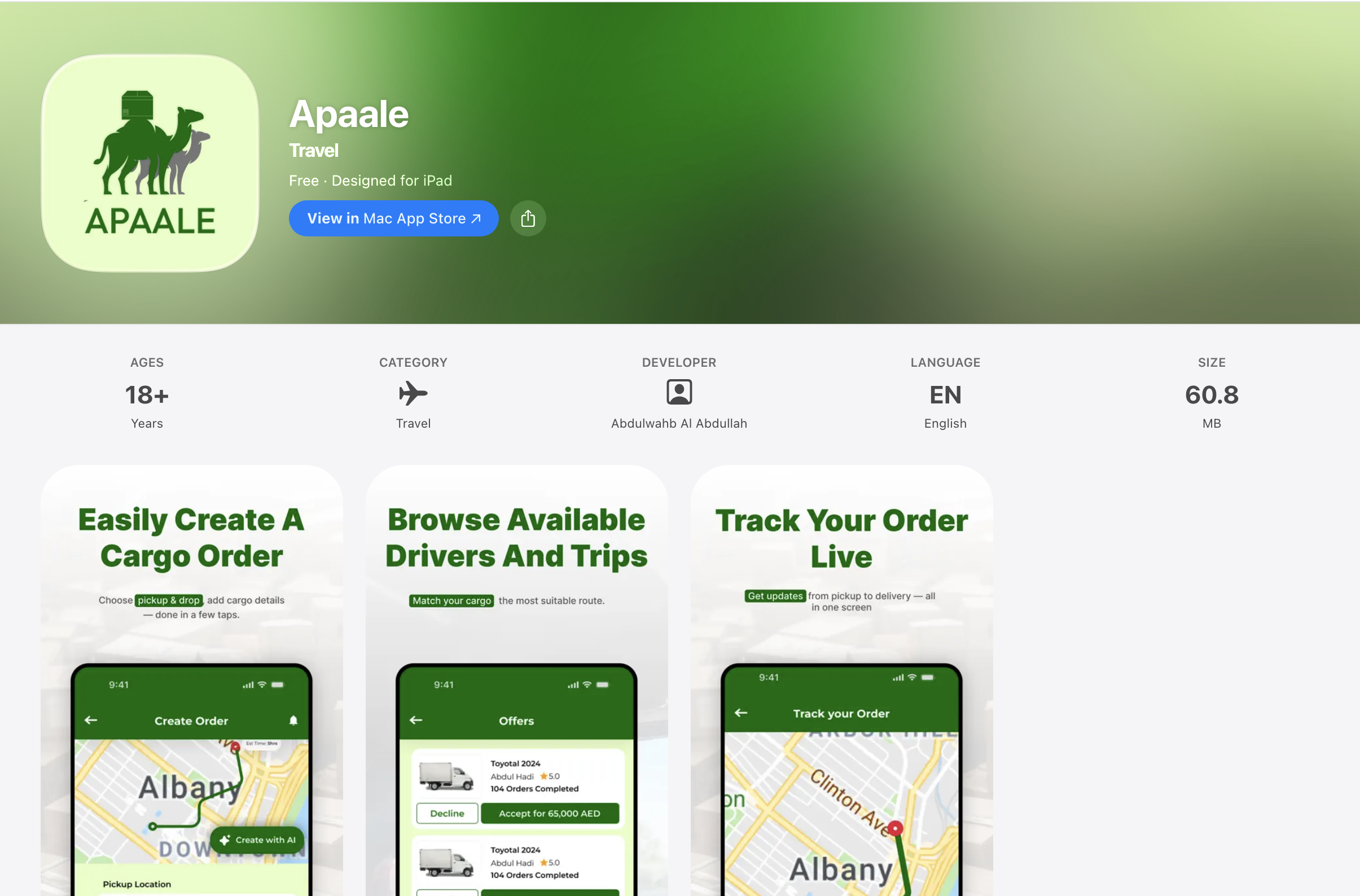
Public product listing
How the experience works
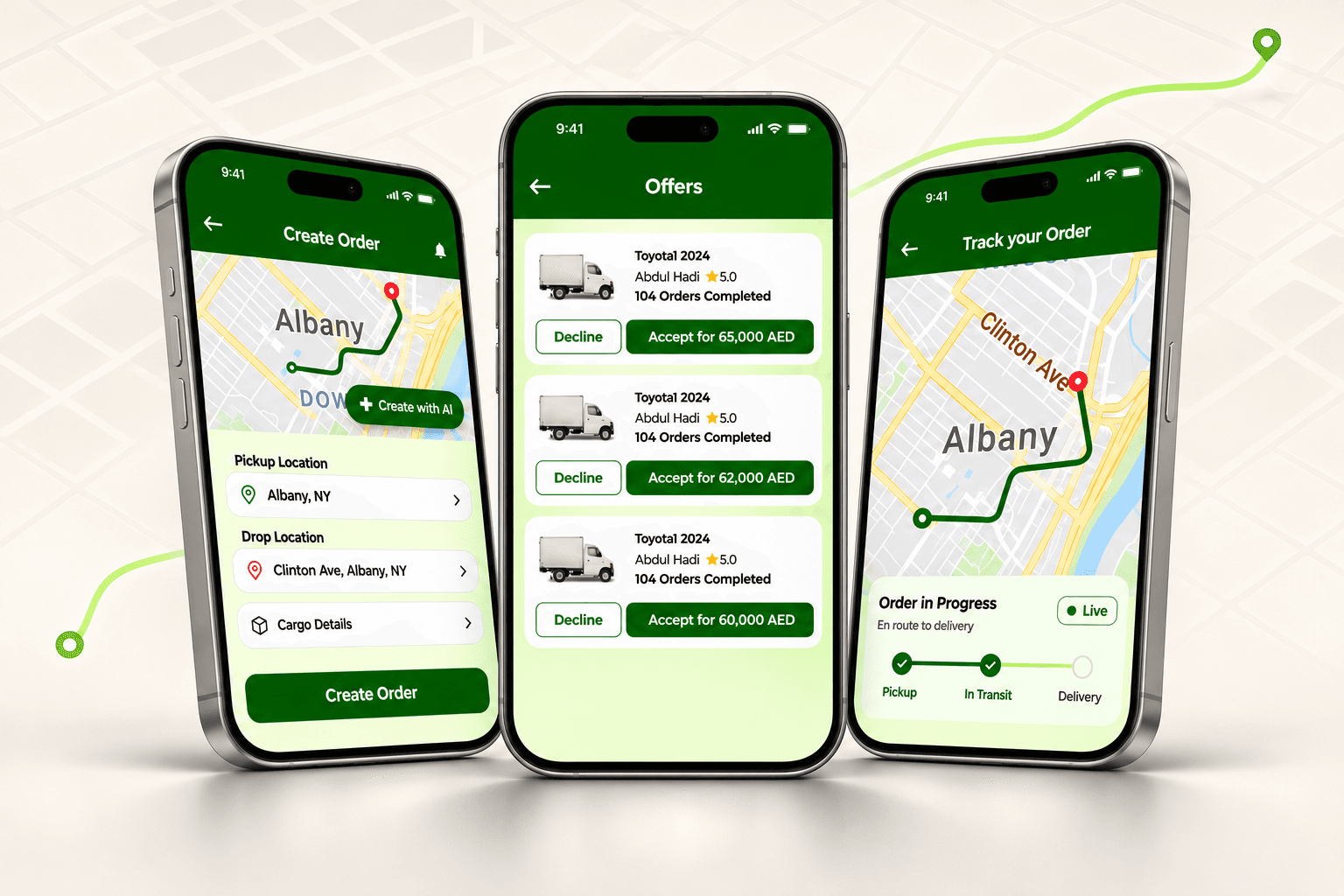
Describe the cargo and its route
The customer journey begins by defining the work that needs to happen. Pickup and destination locations establish the route, while cargo details explain what is being moved. These inputs belong together because they affect which drivers and vehicles are suitable for the request. The interface needs to make the order reviewable before it becomes visible to the driver side.
Maps provide geographic context, but the product cannot rely on the map alone. Written locations, cargo information, and order state remain important when a pin is imprecise or a connection is interrupted. The customer should be able to understand what they are requesting without decoding a route line.
Review offers and choose a driver
Once the request is available, suitable drivers can respond with offers. The customer experience presents the offer alongside the information needed to make a decision, such as the driver or vehicle context and the proposed amount. This is a marketplace moment inside a logistics workflow: the order is not yet an active trip, and the interface should not imply otherwise.
Accepting an offer changes the shared state for everyone involved. Other offers can no longer behave as active alternatives, the selected driver needs the assignment, and operational systems need the same decision. Treating acceptance as one backend-owned transition prevents the customer and driver apps from creating different versions of the trip.
Follow the delivery through completion
After acceptance, the product moves from marketplace coordination into trip execution. Pickup, in-transit, and delivery stages give the customer a readable progress model, while the driver app provides the actions and location behavior needed to advance the work. Notifications bring important changes back to a user who is not watching the application continuously.
Live tracking is useful when it is tied to a clear operational state. A marker without an update time or trip context can create false confidence. The mobile experience therefore needs to represent both progress and the possibility of delayed connectivity, permission changes, or an update that has not yet reached the other side.
My contribution
- Designed and developed Flutter journeys for customer ordering, driver discovery and offers, trip status, and account information.
- Developed the Apaale Driver companion for job discovery, trip progress, maps, earnings context, notifications, and vehicle information.
- Integrated mobile clients with the backend and administrative workflows that coordinate orders, drivers, and operational updates.
- Implemented location-aware interfaces, live tracking presentation, multilingual support, and Firebase-backed notification handling.
- Supported release delivery for the customer and driver products across iOS and Android distribution.
Architecture and implementation
Two Flutter clients around one order contract
Apaale separates the customer and driver experiences into their own Flutter applications. Customers create requests, review offers, and follow delivery progress. Drivers discover relevant work, manage their vehicle context, and advance accepted trips. The applications have different navigation and permissions, but they meet at the same order and trip contract.
The backend and administrative workflows provide the coordination layer. An order identifier, selected driver, current stage, allowed transitions, and latest operational data need one authoritative owner. The clients can then render the actions appropriate to their role instead of independently deciding what the trip means.
Location and map behavior as a lifecycle
Location work spans permission requests, map rendering, route context, update frequency, background behavior, and recovery after the app or network changes state. The driver application has the more demanding write path because its position can contribute to customer tracking during an active trip. The customer side primarily consumes the progress and latest location appropriate to that order.
Collection should be connected to a legitimate active-trip state rather than running indefinitely. A robust implementation also distinguishes a recent update from a stale one and avoids presenting an old marker as continuously live. These concerns are part of the product lifecycle even though the public screenshots show only the visible map and progress interface.
Notifications complement, rather than replace, state
Firebase-backed notifications alert customers and drivers to important events such as an offer, an accepted request, or a trip change. A notification is a prompt to refresh the relevant workflow, not the permanent source of truth. Opening the app should reconcile with the current backend state in case a message was delayed, duplicated, or never delivered.
This distinction keeps operational correctness outside the notification channel. The same principle supports multiple platforms: iOS and Android can have different permission and delivery behavior while the application still resolves the current order through its normal data path.
Key engineering decisions
Model delivery as a shared state machine
Order creation, driver offers, acceptance, pickup, transit, completion, and cancellation are related states rather than independent screens. Both mobile clients need to derive their available actions from the same backend-owned trip state.
Keep customer and driver experiences separate
Customers and drivers share an order but have different jobs, permissions, and navigation. Separate applications let each workflow stay focused while the backend contract remains responsible for keeping both sides synchronized.
Treat location as operational data
Map presentation is only one part of tracking. Location permissions, foreground and background behavior, stale updates, connectivity loss, and trip completion all affect when a position should be collected, transmitted, and shown.
Challenges and trade-offs
Prevent contradictory actions across both sides
A two-sided product can receive actions close together: a customer may cancel while a driver is responding, more than one driver may submit an offer, or a device may retry after a weak connection. The interface needs a clear pending state, while the backend transition needs to be idempotent or reject an action that no longer applies.
The client should then translate the authoritative response into an understandable next step. A stale screen is expected in distributed mobile software; the important behavior is to reconcile it without creating duplicate orders, repeated acceptance, or a trip that appears active for only one participant.
Balance tracking usefulness with device constraints
Frequent location updates can make a route feel responsive, but they also affect battery use, data consumption, and platform background limits. Sparse updates reduce cost and power use but can make movement appear delayed. The appropriate policy depends on trip state, expected speed, foreground status, and operational requirements.
Permissions also change over time. The driver can deny or reduce access after onboarding, the operating system can pause background work, and connectivity can disappear mid-trip. The product needs states for unavailable tracking and recovery rather than assuming that a permission granted once remains available forever.
Keep multilingual journeys aligned
Logistics screens contain addresses, status labels, actions, amounts, and map content. A translated string set is only one part of multilingual delivery. Text expansion, direction, number formatting, and the relationship between translated controls and external map labels all need review in the complete order journey.
Customer and driver releases should use the same agreed terminology for shared states. If one side describes a trip as accepted while the other uses language that suggests pickup has started, the translation becomes an operational problem rather than a cosmetic difference.
Validation and delivery considerations
Test complete customer-driver scenarios
The most valuable validation unit crosses both applications: create a request, publish it, receive offers, accept one, begin the trip, send progress and location changes, complete delivery, and verify the final state everywhere. Each stage should also be repeated after reopening an app or interrupting connectivity.
Negative scenarios matter just as much. Useful checks include two drivers acting on the same request, cancellation at each permitted stage, a rejected stale action, a duplicated network request, notification delay, and a customer returning from an old push message. These scenarios reveal coordination defects that isolated widget review cannot find.
Exercise permissions and real-device background behavior
Location and notification behavior needs real iOS and Android devices because simulator success does not establish background execution, battery behavior, or platform permission handling. Validation should cover foreground use, backgrounding, temporary network loss, permission denial, reduced permission, and return from system settings.
The visible tracking experience should also make freshness inspectable during testing. Testers need to distinguish a genuinely recent location from the last position retained after updates stop. That gives the team evidence for both the collection path and the customer-facing interpretation.
Keep public evidence separate from private operations
The public website and store destinations confirm product availability and show the customer-facing journey. They do not expose the administrative controls, backend logs, production load, or commercial outcomes. This case study therefore explains the integration responsibilities without reproducing private systems or claiming unprovided metrics.
A production review with authorized access would add API and security testing, operational alerting, privacy and retention review for location data, and release-specific telemetry. Those responsibilities remain important, but a public portfolio should not present them as independently verified when the underlying evidence is private.
What was delivered
Customer and driver Flutter applications connected to the Apaale logistics platform, together with customer-facing web access. The delivered mobile scope covers cargo-order creation, offers, trip progress, maps, live tracking presentation, notifications, multilingual interfaces, account and vehicle information, and integration with operational backend workflows.
Visit ApaaleProject scope
- Products
- Separate Apaale customer and Apaale Driver applications with public iOS and Android destinations.
- Journey
- Cargo-order creation, driver offers, and live order progress shown in the archived public listing material.
- Scope
- Flutter customer and driver delivery, maps and location presentation, notifications, multilingual UI, backend integration, and release support.
This case study describes the product journeys and my mobile delivery responsibilities without publishing private backend or admin interfaces. Public listings demonstrate distribution and visible product structure, but they do not establish order volume, active-driver counts, tracking accuracy under every device condition, or commercial outcomes. Those measurements would require authorized production evidence.
Key takeaways
- A logistics interface is only as reliable as the shared order state connecting customers, drivers, and operations.
- Location, notifications, and maps need explicit lifecycle and failure behavior beyond their visible screens.
- Separate customer and driver apps can stay focused while one backend contract keeps their actions consistent.