The product and the problem
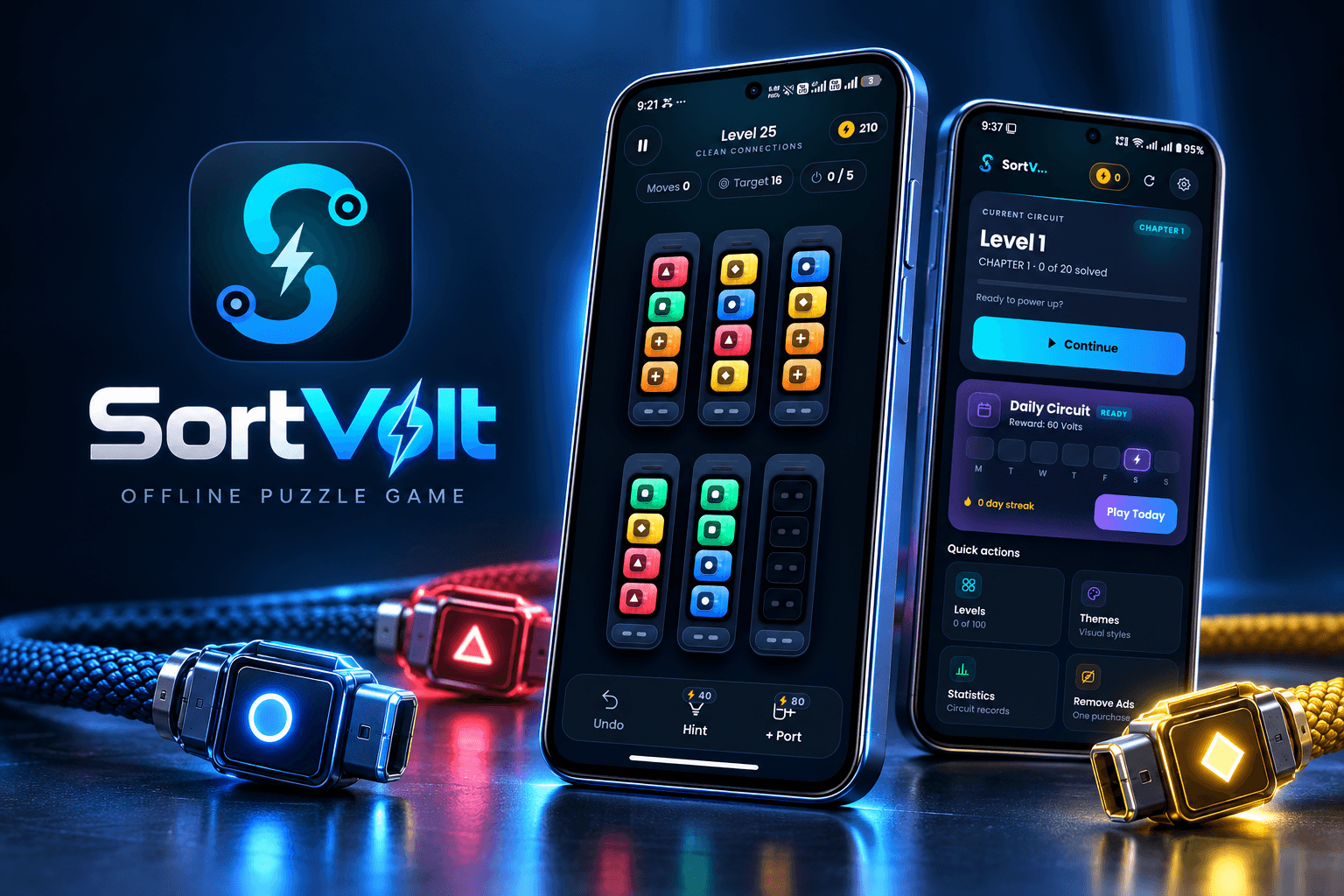
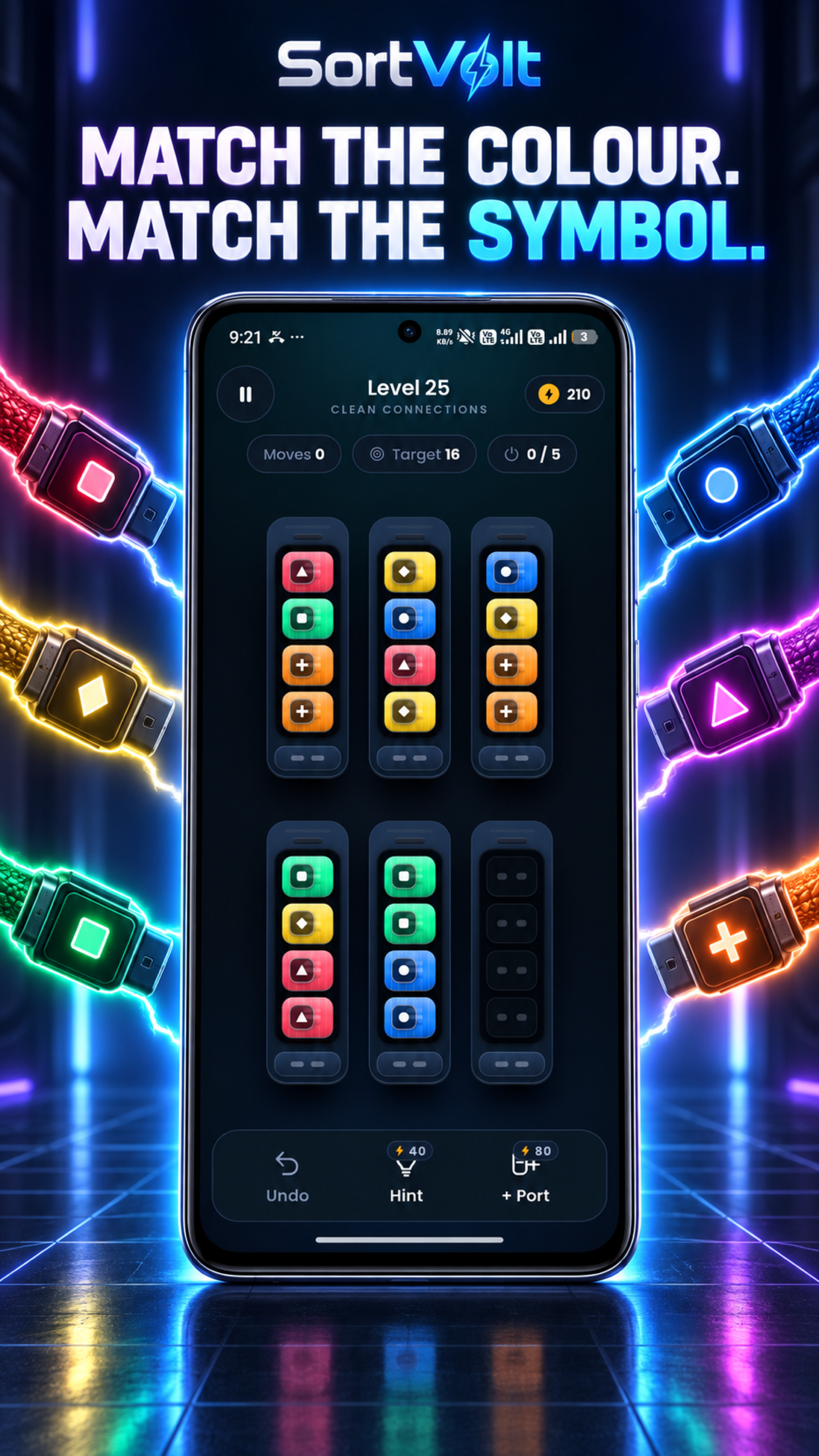
SortVolt uses cable stacks and ports as the basis of a casual sorting puzzle. Colour and symbol identifiers make the matching rule visible, while a defined level structure and local progression give the first version a focused product boundary.
I developed a V1 product/design package covering the game rules, screens, assists, progression, daily challenge, persistence, and optional monetization services. The story focuses on those design decisions and the boundaries of the first version.
Original project artwork
How the experience works
Teach the rule through the first puzzles
The V1 design introduces cable sorting through short, in-game guidance. A player selects a port and then a matching or empty destination. Later tutorial moments introduce a completed set, Undo, Hint, and an Extra Port when those ideas become relevant. This is a planned progression from understanding the basic move to using assistance during a difficult puzzle.
Give every move a clear result
The rule specification defines a port’s capacity, a valid transfer, a completed port, and a completed level. A move needs a non-empty source, destination capacity, and a compatible destination top group or an empty destination. The plan transfers the maximum legal contiguous group and gives a completed port a powered state. These definitions give the visual theme a concrete puzzle model underneath it.
Return through local progress and a Daily Circuit
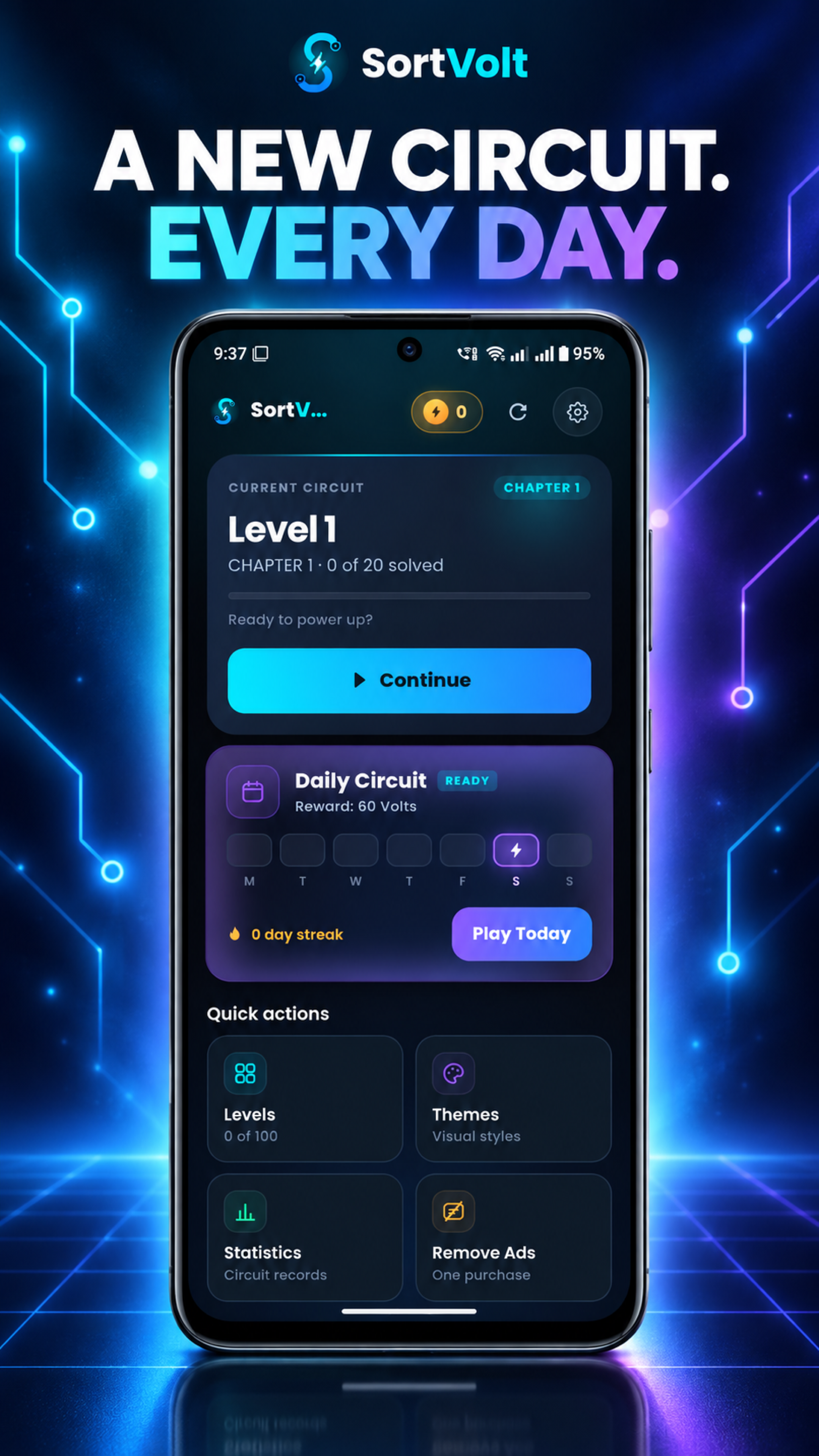
The product direction includes level progress, saved settings, local statistics, and a daily challenge that can work without a custom gameplay backend. The Daily Circuit is specified as a deterministic selection from bundled challenges or a date/version-seeded puzzle. This gives the design a repeat-use path that remains part of its offline-first scope. It is an intended mechanism, not evidence of measured retention.
My contribution
- Defined the first-version game loop and product scope in the V1 product plan.
- Developed the documented visual direction for matching, progression, and daily challenges.
- Specified local state and offline-play boundaries.
- Kept optional analytics, advertising, and purchases separate from the core puzzle rules.
Architecture and implementation
Define a testable puzzle model before adding services
The V1 plan separates puzzle rules from presentation, storage, analytics, advertising, and purchases. Its proposed models include cable types, port state, puzzle state, moves and results, level definitions, and level progress. Those concepts make the rules discussable before treating screen artwork as proof of a completed engine.
A strict gameplay boundary also gives verification a useful target. A port should accept or reject a move according to its state, independently of the animation used to show it. A level should complete according to its matching conditions, independently of an advertisement, a theme, or an analytics request.
Persist enough state to resume a real session
The local-data plan covers unlocked levels, results, best moves, stars, currency, assists, daily history, settings, entitlements, and an active puzzle snapshot. It also calls for schema versioning. These details matter because continuing an interrupted level and preserving long-term progress are different persistence tasks.
The offline requirements apply to launch, level selection, play, completion, locally affordable assists, bundled daily challenges, themes, and statistics. Connected services have fallback behavior: remote configuration uses local defaults, unavailable ads have a clear outcome, and purchases can be retried later. This is the intended V1 contract, with implementation verification kept separate.
Keep commercial systems at the edge of the puzzle
The plan includes optional rewarded ads, restrained interstitial behavior, and a permanent remove-ads purchase. Those systems need their own availability, consent, cancellation, restoration, and cached-entitlement handling. They are integrated around the puzzle experience rather than used as its rule engine.
This separation is useful when assessing the first release. A disconnected device should still have a coherent local game, while a paid user’s commercial entitlement has its own store-related lifecycle. The case study describes that product/design reasoning without claiming verified revenue, purchase restoration, or a completed store test matrix.
Key engineering decisions
Keep the core local
The V1 plan avoids accounts and a custom gameplay backend. Core puzzles and progress are intended to work without a network service.
Pair colour with symbols
Connector symbols give players a second matching cue alongside colour, carrying the intended matching rule through the visual design.
Keep monetization outside the game rule
Optional ads, assists, and a permanent remove-ads purchase are specified separately from the core matching rule. This keeps commercial integrations from defining how the puzzle itself works.
Challenges and trade-offs
A legal hint is not automatically a useful hint
The design plan explicitly rejects random legal moves as the hint strategy. A hint should move a player toward a known solution, avoid loops, and remain useful if the player has deviated from an expected path. The proposed approaches use a stored/generated solution trace or a solver that works from the current state.
That turns Hint into a small reasoning problem with its own acceptance criteria. The product artwork can show a Hint button, but the implementation still needs to establish what the button recommends and whether that recommendation advances a solvable puzzle.
Build difficulty and recognition into the system
The V1 direction pairs colour with connector symbols, giving the player more than one visual cue for matching. The difficulty plan also varies cable groups, port arrangements, and helper space over the level sequence. These choices belong to the underlying level design as well as its visual theme.
The same care applies to assistance and rewards. Undo, Hint, Extra Port, and Restart need understandable effects and predictable persistence. Colour-and-symbol matching is a documented design choice; it is not presented as an independently tested accessibility certification.
Validation and delivery considerations
Validate level data before interpreting player outcomes
The proposed validation process checks cable counts, capacity, known identifiers, solvability, target moves, duplicate identifiers, and chapter assignment. These are objective properties of the puzzle data. A development report would make invalid content visible before using completion or abandonment behavior to judge difficulty.
The core test matrix also covers grouped transfers, empty and matching destinations, full or invalid destinations, Undo chains, Restart, background/resume behavior, and level completion. They are planned verification cases in the design package, not a passed test report supplied with this portfolio.
Review connected failures alongside offline play
The V1 acceptance direction includes unavailable ads, rewarded-ad dismissal, offline operation, purchase cancellation and pending states, restoration, local-data migration, daily rollover, and remote-configuration defaults. A release decision would need evidence across those boundaries, beyond screenshots of a successful game.
That is why this entry is labelled Product & design. It explains the rules, engineering boundaries, artwork, and acceptance plan that define the direction. Build/release evidence and product measurements would be additional inputs before extending the story into implementation outcomes or commercial results.
What was delivered
A V1 product/design package with game rules, intended progression, screen concepts, release artwork, and a public product page. The artwork illustrates the product direction; it is separate from evidence that every planned feature shipped.
Visit product websiteProject scope
- Visuals
- Original cable-puzzle and daily-challenge promotional artwork.
- Scope
- V1 game rules, screen designs, non-goals, and acceptance criteria.
- Focus
- Local progression, colour-and-symbol matching, and a bounded first-version direction.
This is a product/design case study. Planned level counts, monetization behavior, purchase restoration, and release acceptance criteria are not presented as verified implementation results. No retention or revenue outcome is inferred from the artwork.
Key takeaways
- A recognisable puzzle identity works best when every visible interaction maps to a precise rule and state change.
- Offline progression, active-level recovery, and daily selection need explicit persistence and versioning decisions.
- Solvability checks, useful hints, and commercial failure handling deserve evidence separate from the release artwork.