The product and the problem
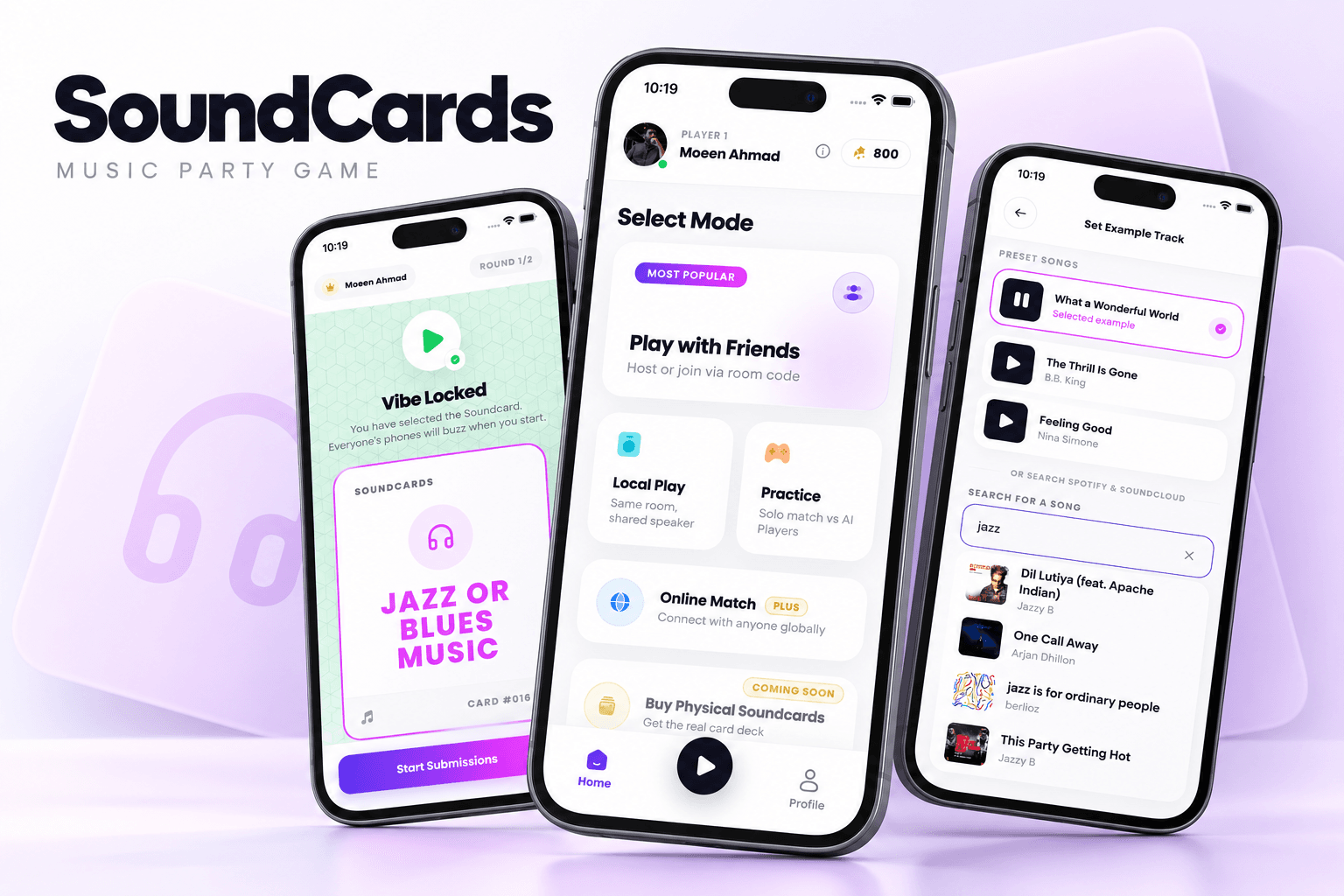
SoundCards turns music taste into a social game. Players draw a genre card, submit songs, listen to anonymous choices, and let a rotating judge select the winning track. The interface needs to make each stage understandable when people are sharing a device or moving through a round.
I designed and developed SoundCards from start to end, including its admin dashboard. The local-play foundation made the core game loop explicit before the product expanded into the wider experience now shown on its public site.
Original product screens
How the experience works
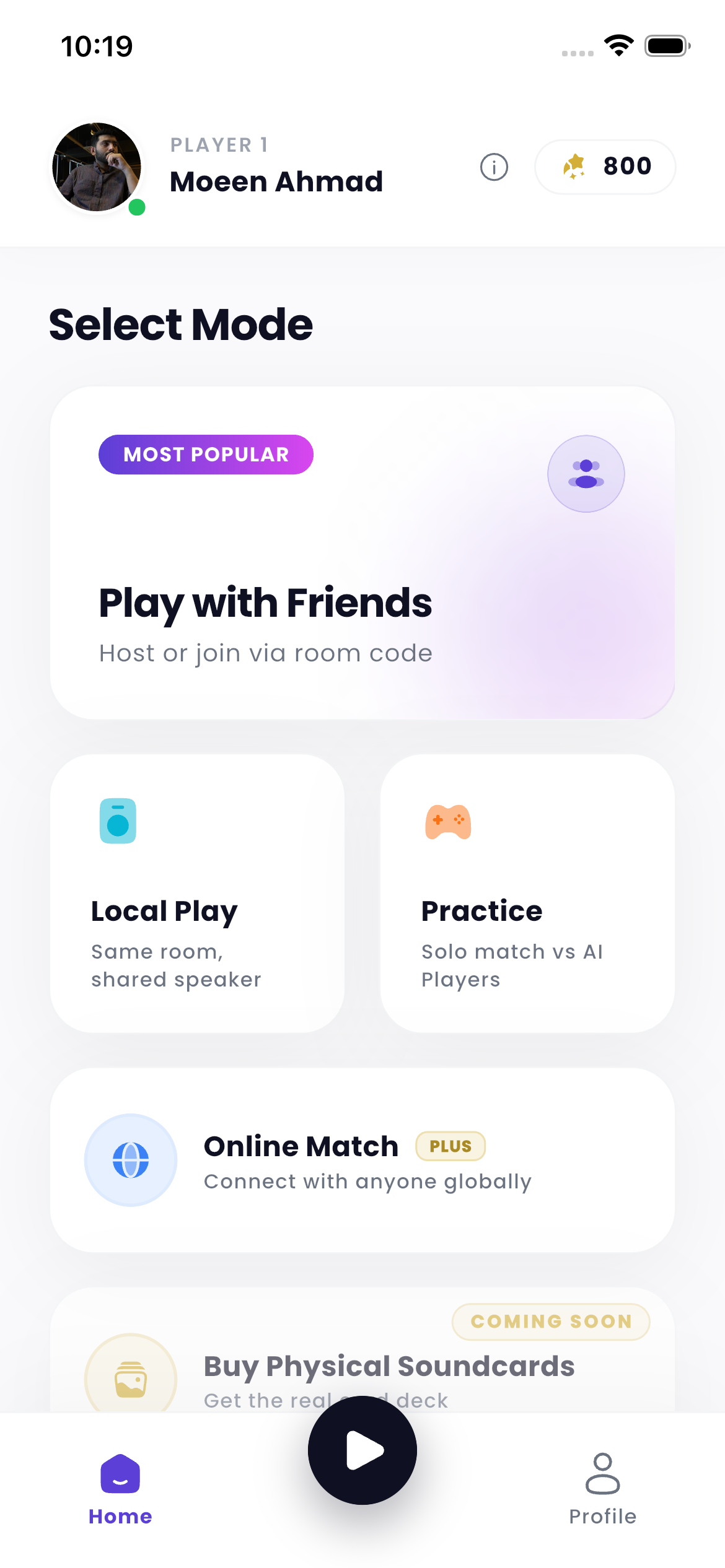
Get a group into a local game
The documented local-play design starts with a host or guest entry and a short setup flow. The group enters player names on one device, reviews the rules, and moves into a session. Other people in the room participate as in-session players. This is an important product choice because the social activity can begin without making every participant complete an individual account flow.
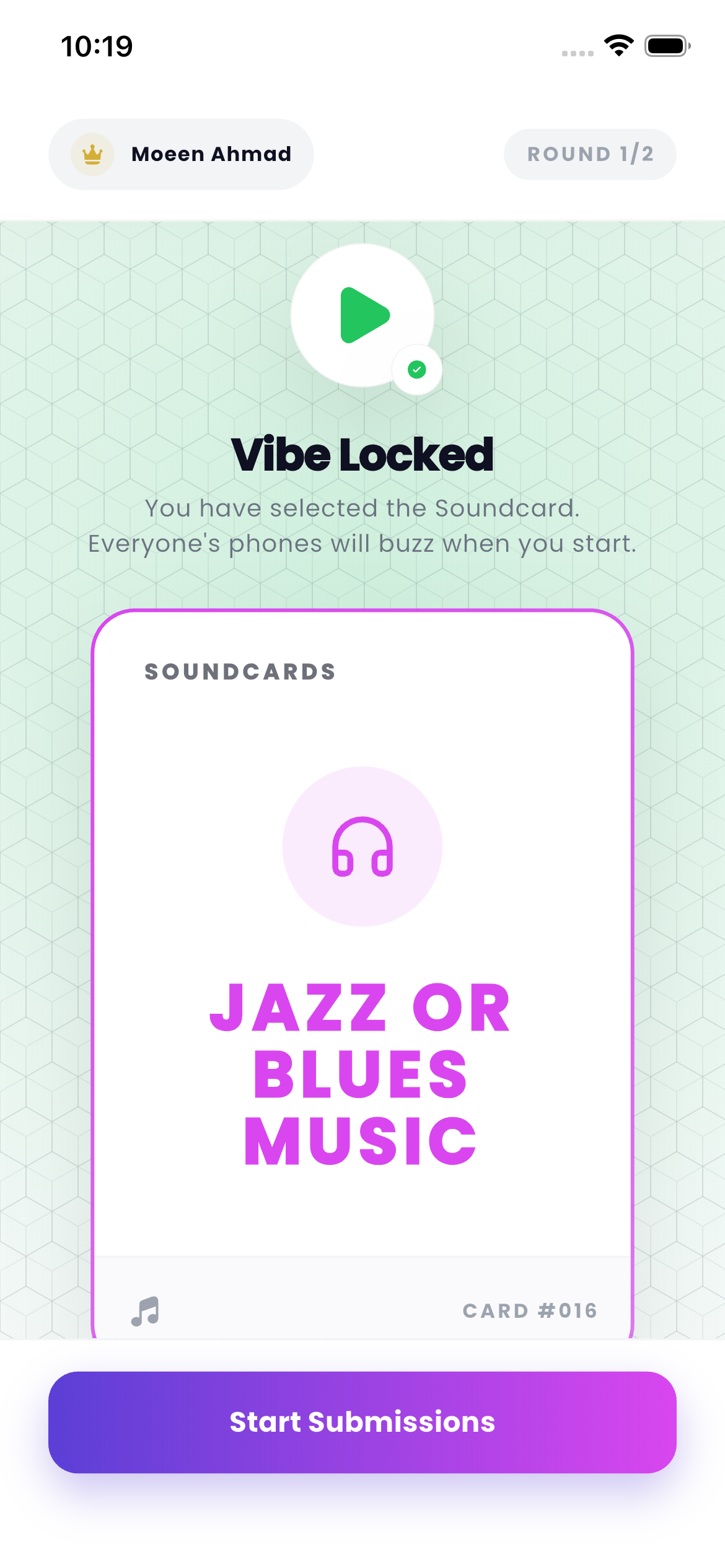
Give each round a visible owner and prompt
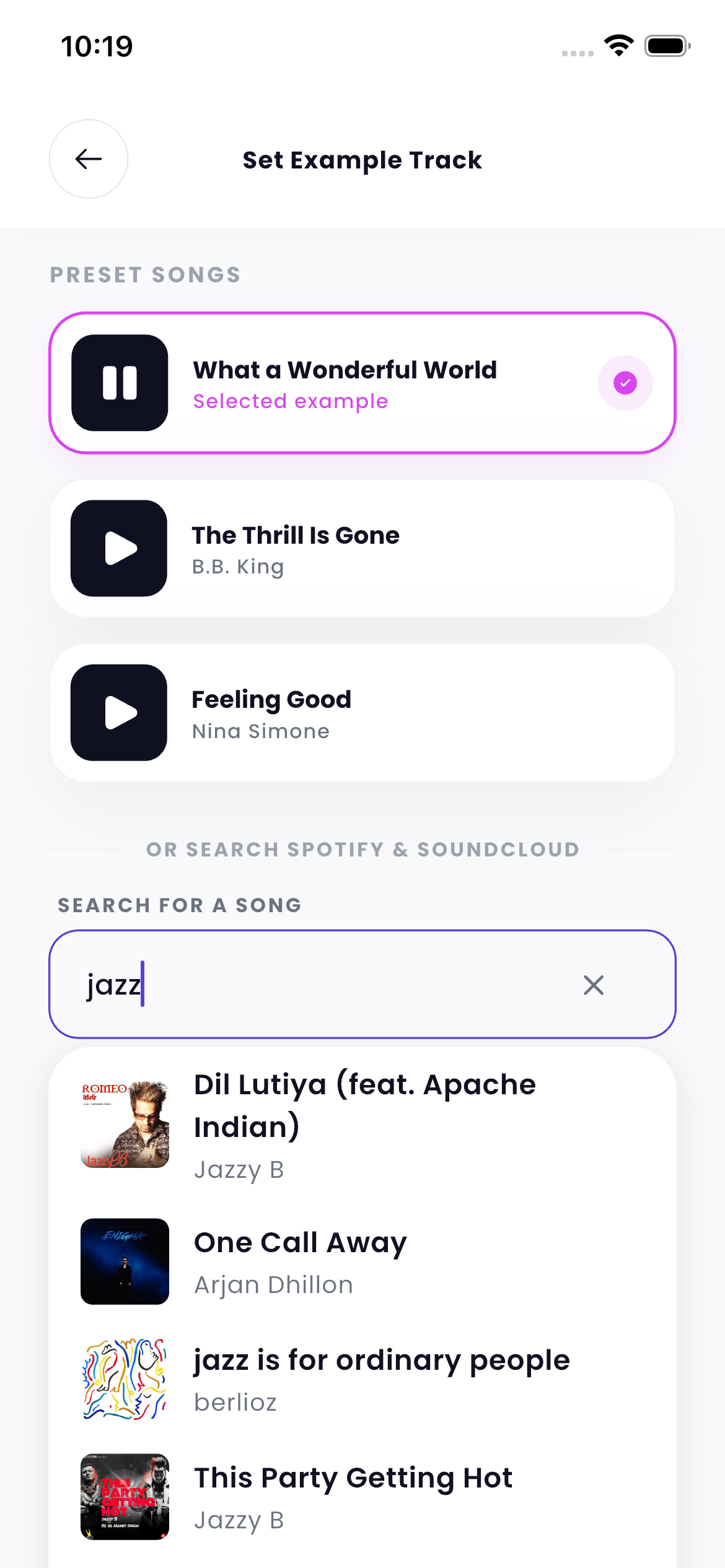
A round identifies its judge and reveals a music-genre Soundcard. The flow includes an example-song stage and support for a custom prompt through a “You Decide” card. At each transition, the interface needs to explain who is acting, what the current prompt is, and what the group should do next. The round becomes understandable through its sequence as well as its visual design.
Submit, reveal, judge, and continue
Players pass the device and submit songs in sequence. Entries are prepared for anonymous reveal, the judge chooses a winner, and the scoreboard records the result before the judge role rotates. The documented game rules complete a judging cycle before the group ends or continues. That ties the champion flow to the round model and gives the group a coherent way to finish a session.
My contribution
- Designed and developed the Flutter app from initial flows through product delivery.
- Modeled the core setup, submission, reveal, judging, scoring, and champion journey.
- Developed the admin dashboard used alongside the mobile product.
- Carried the product from documented flows into a publicly presented app.
Architecture and implementation
A game flow with explicit state transitions
The project plan separates setup, deck handling, submission, anonymous reveal, judging, scoring, and champion presentation into recognizable modules. These transitions define the core product contract. Moving to a new screen also means advancing the game state: the active player, current judge, submitted entries, score, and next permitted action all need to agree.
The documented Flutter direction uses feature-first Clean Architecture, Provider, GetIt, and GoRouter. That keeps the round rules separate from individual widgets and makes navigation follow the same underlying session. The value is practical: a visually polished round can still fail if the screen and game state disagree about whose turn comes next.
Separate account identity from party participants
Firebase Authentication and profile storage belong to the host/account side of the product. The local-play design gives other participants names within the current game, and the guest route bypasses account creation for local play. These are different kinds of identity, with different persistence and access expectations.
The original plan also distinguishes an immediately playable local product from future online foundations. The public website now presents a wider experience, so the case study focuses on my documented design, app development, and dashboard responsibility while preserving that version boundary. It does not attribute every later online capability to the initial local-play package.
Keep administration outside the player journey
I also developed the admin dashboard alongside the mobile game. An operational interface has a different purpose from a screen used during a party: the product team needs to manage the application while players need clear, immediate round actions. Treating those surfaces separately keeps their responsibilities understandable.
The public story uses the real player-facing product screens and discusses the administration work at a scope level. It does not reconstruct private dashboard screens or assume capabilities that are absent from the supplied project material.
Key engineering decisions
Make the round state visible
Each step tells the player what happens next: submit, reveal, judge, or review the score. A defined round flow keeps timers, anonymous choices, judge rotation, and score changes understandable.
Define local-play identity separately
The original local-play design uses one host and in-session player names. It avoids requiring every player sharing the phone to create an account.
Keep administration separate from play
The admin dashboard gives the product team a separate operational interface. Private management screens are kept separate from the public player experience.
Challenges and trade-offs
Timers need an outcome the group understands
The game specification includes a timed submission window, a low-time warning, and a separate judging window. A timeout is therefore a real branch of the experience. The player needs to understand that their turn ended, and the session needs a defined next step that lets the group continue.
The screen-flow material covers skipped submissions, a judge who does not choose in time, and the case where only one player submits. These details matter because a party game encounters incomplete participation as part of normal play. The design needs to explain those outcomes while preserving the round and score rules.
Preserve anonymous judging across the hand-off
Song entry happens while people are sharing the device, while judging is designed around anonymous choices. The transition between those stages is a product boundary. The submission interface needs enough context for the person entering a song, and the reveal needs the information appropriate to the judge.
The scoreboard then reconnects the selected song to its player and applies the result once. Separating submission, reveal, and results makes the intended fairness rule visible and gives the implementation clearer places to manage the hand-off.
Validation and delivery considerations
Review the game through complete cycles
A useful acceptance walkthrough starts with setup and follows the group through a complete judging cycle, including the final score and the choice to continue or end. Looking at isolated screens would miss errors in judge rotation, round completion, or the transition from the scoreboard to the next prompt.
The documented edge cases add valuable review scenarios: an empty or skipped entry, a single submission, a tied result, restarting, and returning home. These are specification-driven review priorities, rather than a claim that an unavailable execution log proves every scenario passed.
Keep delivery evidence connected to the version
The project combines my end-to-end design and development responsibility, the local-play flow documents, a public product website, and current screenshots. Together they explain the delivery context and show how the playable experience is presented. Each source contributes a different kind of evidence.
Product screenshots can demonstrate interface structure, while source plans explain intended rules and scope. Neither provides a measured player count, retention improvement, or revenue result. The case study therefore describes the game mechanics and delivery work directly, with the version boundary stated alongside them.
What was delivered
A Flutter music-game app and an admin dashboard, developed from initial design through delivery. The case study focuses on the core round journey and the end-to-end development responsibility.
Visit product websiteProject scope
- Product
- Public music-game website with product screens and distribution links.
- Game flow
- Setup, submission, reveal, judging, scoring, and the champion journey.
- Responsibility
- End-to-end app design and development, together with the admin dashboard.
This story focuses on the documented local-play foundation and app/dashboard delivery. The current public website describes a broader product; those later features are not treated as part of the same delivery without a version-specific breakdown. No player, revenue, or engagement metrics are claimed.
Key takeaways
- A social game needs clear turn ownership and complete round transitions as much as attractive individual screens.
- Guest access and in-session player names reduce setup work for the documented single-device experience.
- Timers, missed actions, anonymous reveal, and cycle completion belong in the core game specification.