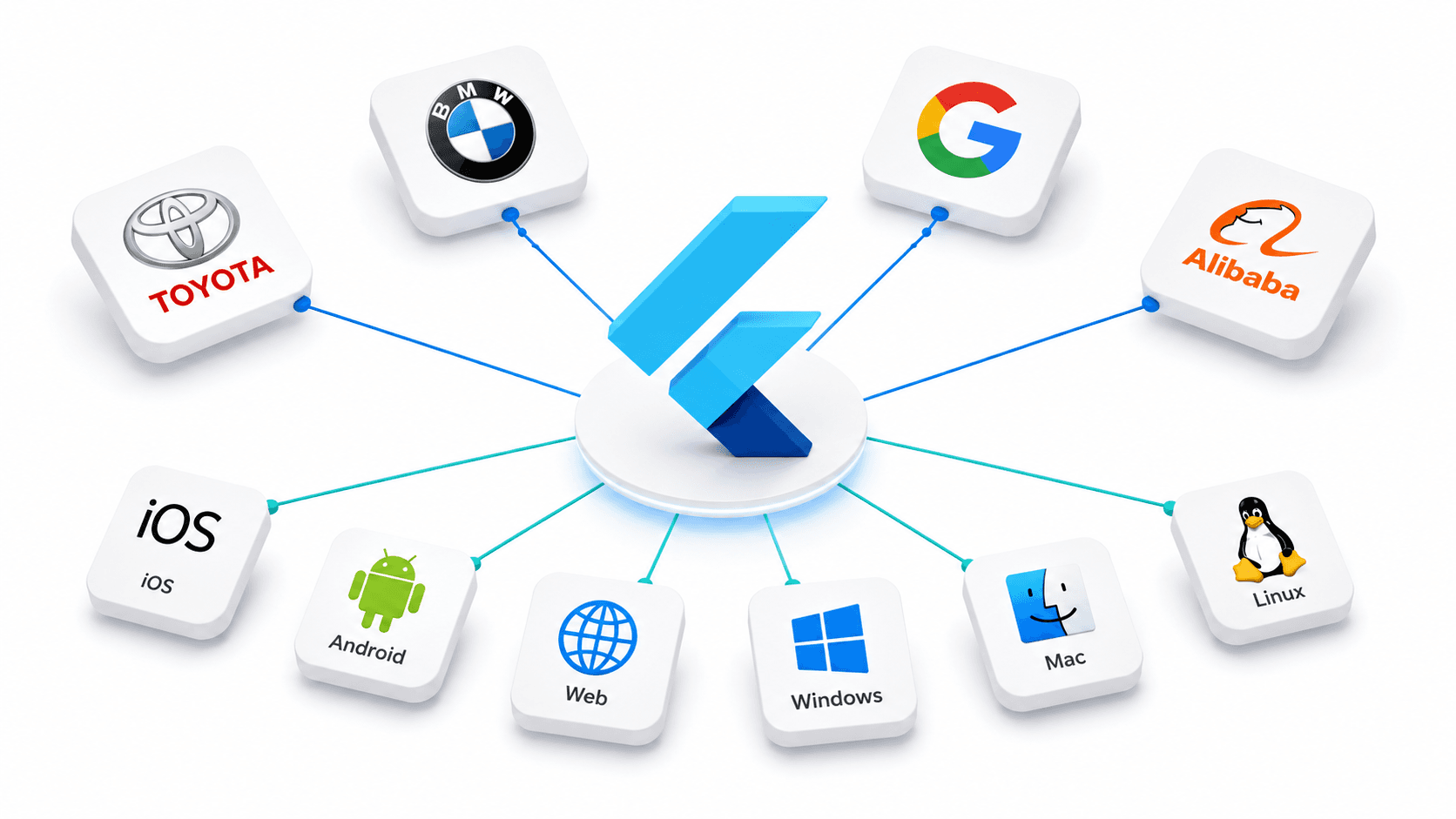
Introduction
Every year developers ask the same question: which mobile framework should I learn? In 2026, that question has a clear answer: Flutter.
Not because of hype. Not because of trend charts. Because of the companies shipping Flutter to millions of users right now, the job market data, the technical advantages that have only grown stronger over the past four years, and the simple economic reality that Flutter developers can build, ship, and maintain software faster than teams using any other mobile stack.
This is the complete case for why Flutter is the best investment of your learning time in 2026.
Real Companies, Real Users, Real Scale
The most convincing argument for Flutter is not benchmarks - it is production usage at companies with extremely high engineering bars.
Google built Flutter and uses it internally at scale. Google Pay - the payments platform processing billions of transactions - runs on Flutter across iOS and Android. The Google Ads app, used by marketing teams managing hundreds of millions in ad spend, is Flutter. When Google uses its own framework for its highest-stakes consumer products, that is the strongest possible endorsement.
BMW
The BMW iDrive in-car infotainment system runs on Flutter. BMW chose Flutter not for a simple utility app but for the primary interface drivers interact with every time they get in the car - displaying speed, navigation, media controls, and vehicle telemetry. This is safety-critical, performance-critical software running on embedded hardware, and BMW chose Flutter.
Toyota
Toyota's North American in-vehicle infotainment systems run on Flutter. When two of the world's largest automakers independently chose the same framework for their most critical embedded UI, it signals that Flutter's rendering performance, reliability, and cross-platform reach are genuinely enterprise-grade.
Alibaba
Xianyu - Alibaba's secondhand goods marketplace with over 50 million users - is built on Flutter. Alibaba actually contributed significantly to Flutter's development in its early days, particularly pushing performance improvements for high-traffic list-heavy UIs. With 50 million users generating real commerce transactions, Xianyu is one of the largest Flutter apps in the world by user volume.
Other Notable Companies Using Flutter
| Company | App | Users |
|---|---|---|
| eBay | eBay Motors | Millions |
| Nubank | Digital Banking App | 80+ million |
| Grab | Super App (SE Asia) | Tens of millions |
| Square | Point of Sale | Millions |
| Tencent | Multiple apps | Hundreds of millions |
| Philips Hue | Smart Lighting | Millions |
| New York Times | Games (NYT Crossword) | Millions |
The Technical Advantages That Actually Matter
1. One Codebase, Truly Multiple Platforms
Flutter compiles to:
- iOS (ARM64)
- Android (ARM/ARM64)
- Web (JavaScript/WASM)
- macOS (native)
- Windows (native)
- Linux (native)
- Embedded (Toyota, BMW)
React Native bridges to native components. Flutter renders its own pixels using the Impeller graphics engine. This means:
- No "bridge bottleneck" performance issues
- Identical UI on every platform
- True code reuse (not just logic sharing)
2. Performance That Rivals Native
Flutter compiles Dart to native ARM code. There is no JavaScript engine, no bridge, no runtime interpretation. The result is 60fps (or 120fps on capable devices) rendering with smooth animations that are genuinely indistinguishable from native apps.
The Impeller rendering engine (now stable since Flutter 3.16) replaced Skia as Flutter's default renderer on iOS and Android, eliminating the shader compilation jank that was Flutter's most common performance complaint.
3. Hot Reload: The Developer Experience Advantage
Flutter's hot reload is not a minor convenience - it is a fundamental speed multiplier. Make a change to your UI, widget logic, or state - see the result in under a second without losing app state.
In practice, this means a Flutter developer can iterate through 10 UI variations in the time it takes a native iOS developer to run one build cycle.
4. A Single Language For Everything
Dart is clean, statically typed, and genuinely pleasant to write. More importantly, you learn it once and use it everywhere: mobile UI, business logic, backend services, command-line tools, and now even compiled to WebAssembly.
Compare this to a native mobile team that needs Swift developers (iOS), Kotlin developers (Android), and JavaScript developers (web) - three languages, three ecosystems, three sets of dependencies to manage.
The Job Market Reality in 2026
The Flutter job market has matured significantly since Flutter 1.0. Key signals:
Demand is global: Flutter roles are posted across North America, Europe, the Middle East, and Southeast Asia. The framework's cross-platform nature is particularly attractive in markets where companies need to reach both iOS and Android users simultaneously without doubling engineering headcount.
Salary premium: Flutter developers command salaries competitive with native iOS/Android developers, with a premium for senior engineers who also understand state management patterns, CI/CD pipelines, and backend integration.
Startup advantage: Flutter lets early-stage startups build their entire mobile product with one developer. A solo Flutter developer can ship on iOS, Android, and web simultaneously - something impossible with native development. This makes Flutter skills especially valuable in the startup ecosystem.
Enterprise adoption: The BMW and Toyota use cases signal something important: Flutter is not just for startups anymore. Enterprise engineering teams are adopting it for mission-critical products, creating demand for senior Flutter engineers who understand architecture, testing, and maintainability at scale.
Flutter vs The Alternatives in 2026
Flutter vs React Native
| Factor | Flutter | React Native |
|---|---|---|
| Performance | Native-compiled, no bridge | JavaScript bridge |
| UI consistency | Pixel-perfect across platforms | Platform-native components |
| Hot reload | Yes (sub-second) | Yes (slightly slower) |
| Web support | First-class | Experimental |
| Desktop support | Stable (Win/Mac/Linux) | Limited |
| Language | Dart (typed) | JavaScript/TypeScript |
| Company backing | Meta | |
| Embedded use | BMW, Toyota | Uncommon |
React Native is a legitimate framework with strong adoption. But Flutter wins on rendering consistency, performance, and platform breadth.
Flutter vs Native (Swift/Kotlin)
Going native gives you the absolute best platform integration and first access to new OS features. But the cost is two separate codebases, two teams, and doubled maintenance.
For most products - even complex ones - Flutter achieves 95% of native performance with 50% of the development cost. That is the trade-off enterprise teams like BMW and Alibaba have explicitly made.
Flutter vs Kotlin Multiplatform (KMP)
Kotlin Multiplatform is Google and JetBrains' approach: share business logic in Kotlin, keep native UIs per platform. It is powerful but fundamentally different from Flutter - KMP shares code, Flutter shares everything including rendering.
Flutter remains ahead on developer ecosystem maturity and tooling quality.
The Ecosystem in 2026
Flutter's pub.dev package ecosystem has over 40,000 packages covering virtually every mobile development need:
- State management: Riverpod, BLoC, Provider, GetX
- HTTP: Dio, http
- Local storage: Hive, Isar, SQLite, SharedPreferences
- Authentication: firebase_auth, local_auth (biometrics)
- Maps: google_maps_flutter, flutter_map
- Payments: in_app_purchase, RevenueCat
- AI: langchain_dart, openai_dart
- Push notifications: firebase_messaging
- Analytics: firebase_analytics, Mixpanel
Whatever you need to build, there is almost certainly a mature, maintained Flutter package for it.
Flutter in AI-Powered Products
One of the most exciting developments of the last two years is Flutter becoming the natural choice for AI-powered mobile apps. The combination of:
- Flutter for the cross-platform UI layer
- Dart for lightweight client-side logic
- FastAPI/Python for AI backend (LangChain, RAG, agents)
- Simple HTTP/WebSocket integration between them
...creates a clean, productive stack for building AI-first mobile products. Companies building AI assistants, recommendation engines, and generative features are increasingly choosing Flutter for the frontend because it lets one developer ship on all platforms simultaneously.
Conclusion
Flutter's case in 2026 is stronger than ever. Google uses it for Google Pay. BMW and Toyota use it for in-car systems. Alibaba serves 50 million users through it. Nubank serves 80 million banking customers with it.
These are not experimental pilot projects - these are core product decisions made by companies with elite engineering teams who evaluated every option and chose Flutter.
For an individual developer, the calculation is straightforward: one framework, one language, six platforms, a massive ecosystem, strong job market, and a genuine performance advantage over the alternatives. Flutter gives you more leverage over your time than any other mobile technology available today.
If you are deciding what to invest your learning time in for 2026, Flutter is the answer.
Ready to build a cross-platform mobile app with Flutter? I build production-ready Flutter applications for iOS, Android, and web - with clean architecture, CI/CD automation, and full backend integration. Book a meeting to start your Flutter project.
Written by Moeen Ahmad, Senior Software Engineer working across mobile apps, backend systems, cloud deployments, and AI-powered products. I write about practical engineering, real project lessons, and building software that actually ships.
Interested in working together?
Let's discuss your project and explore how I can help bring it to life.